

— Annie Liebovitz
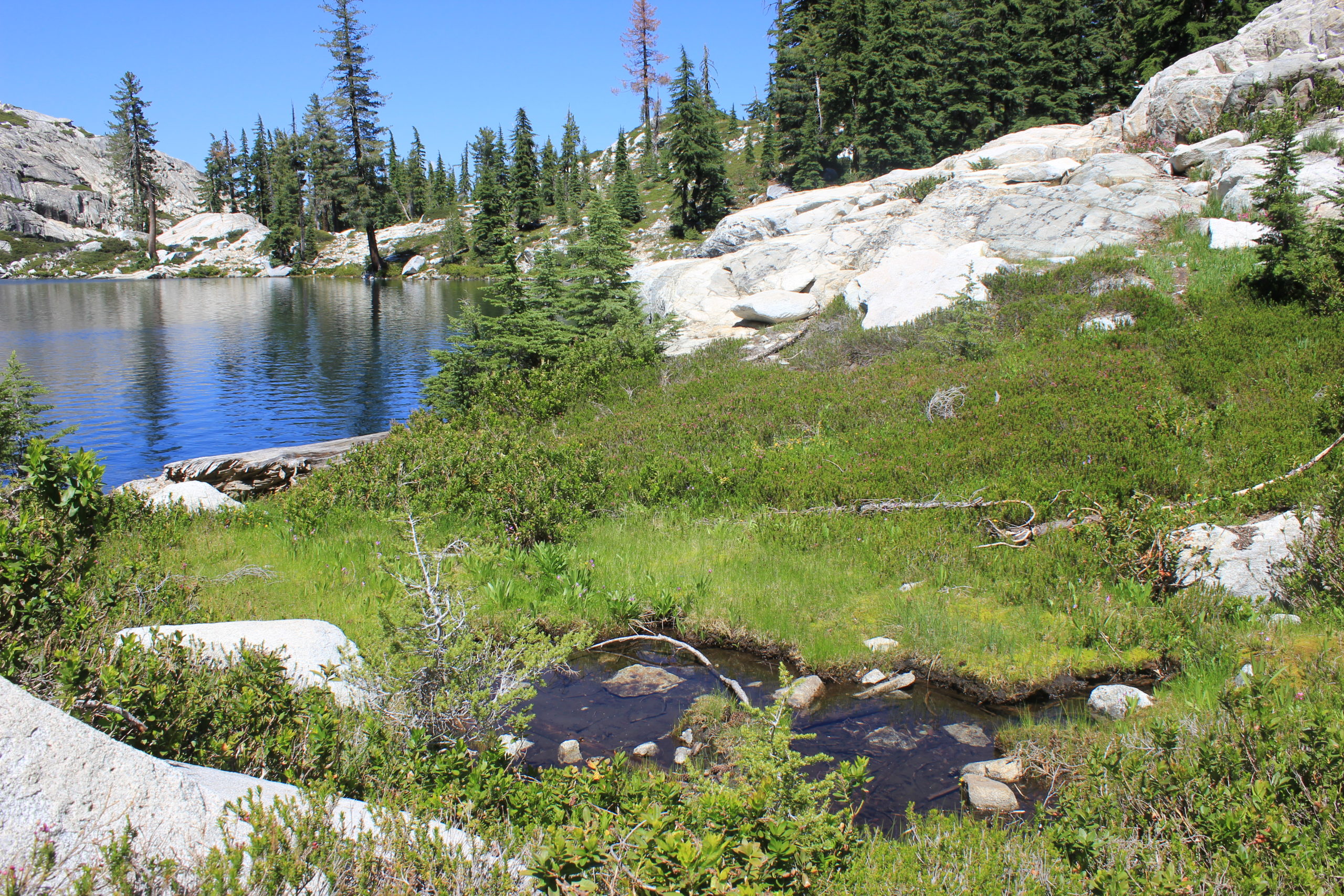
As the incredibly magical afternoon matinee shined on the silver screen for only me, I moved to a convenient rock bench in the shade, from which I could observe the entire lake. I was so much a part of the landscape that when I sat and looked at it, I could feel it looking back at me. To be still in the wild and observe the natural rhythms is to validate one’s existence as an integral part of a larger composition. The mind slips back into its primordial oneness with the greatest of ease, as soon as it escapes from the artificial need to evaluate, decide, and compartmentalize. Conversely, the further we get from nature, the more isolated we become, and the dis-ease of disassociating with the essential reality makes us irritable, sick, and lonely. With the advent of language, humans began to move away from the natural rhythms of earth, according to David Abram in his superb and revealing book, The Spell of the Sensuous. In it, he makes the case that once we started substituting our impressions of the untrammeled world with symbolic alphabets and words, it placed us on a slippery slope that has now led us to the brink of dissolution because of our profound disconnection with reality. When I sit and stare at the landscape, words become superfluous, and I am once again immersed in the essential cadences of the “more-than-human” world, as Abram called it.
With the development of “civilization,” and especially with the mechanisms of industry, humans began fashioning an artificial world to replace the tangible one that was their birthright. A “new world,” or complex society of rules and behaviors that divided everything by value and taxonomy replaced the primal sense of oneness; further separating us from Mother Nature. Our manic desires for mastery, industry, and economic development compelled us to exploit our world for its resources, and we saw ourselves as the rightful owners of everything that existed. This perception further separated us from the whole, and fed the flames of lust for material goods and power. Now we find ourselves in an alien place of our own design: a compound, artificial construct, where technology and the Internet have become the dominant paradigm. We have piled most of our social and economic eggs into this new and attractive basket, but at what cost? Not only is our tenuous way of life more susceptible to collapse, but we have further distanced ourselves from the ecosystem. I have found a “career” in technology, as have millions, but my chosen profession hangs by the thinnest of threads. All it would take is a major power outage, malicious hacking, or simple human error to bring down the entire house of cards….and then what? No technology is needed to understand everything that already is.
As a result of our disconnection, we find ourselves further removed from nature than ever before in history. We anxiously depend on complicated innovations that will make our lives better, or take us out into space, instead of calmly observing the ground beneath our feet, and learning again what it has to teach us. This dichotomy agitates our selfish, tribal instincts, until we see each other only as adversaries that must be responded to with hostility and defensive xenophobia. The dominant social interchanges are now on the Internet, where outrage and antipathy fuel our attitudes and responses towards one another. Society has become a contest to see who can come up with the cleverest ways to insult the “other” groups better.
What’s worse, in their zeal to classify and control for profit, the wizards of technology have created algorithms that exploit our selfish tendencies, and feed us biased information the way lab blocks are fed to rats. As a result, we will only become more divided, adversarial, and desperate. Early in my life, the singers sang about “we are the world,” and “I’d like to teach the world to sing in perfect harmony.” Well, that didn’t happen, and now the songs are more about entitled vanities and false hopes. What are the chances that we might all join together and sacrifice our privileges to prevent the world from permanent damage?
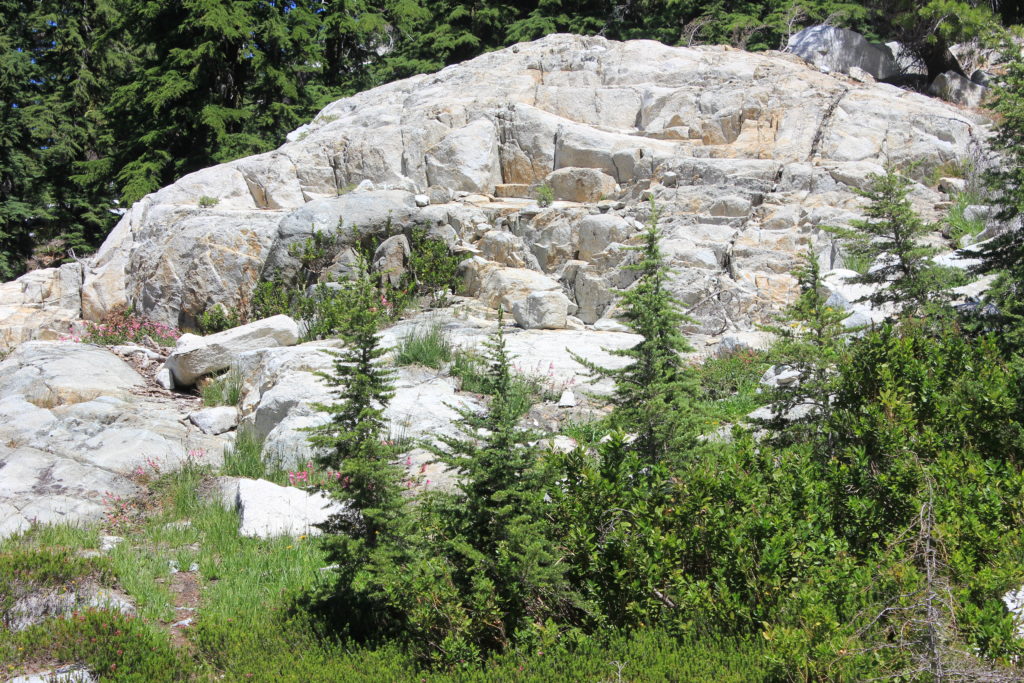
On the lake side of the forest, I inspected the campsite of the double-dads, and found they did an excellent job of putting out their fire and removing all traces that a pair of preteen boys came of age in that location. Only the telltale, sticky remnants of toasted marshmallows in the fire pit give any hint of their gleeful vacation in the mountains. I silently blessed them all, wishing the boys might someday bring their own children back here, and that it would be just as clean and unspoiled. Later, I enjoyed a tuna sandwich for lunch – but without the mayo, lettuce, tomatoes, onions, or even the bread! Then I carefully meandered over to Bumblebee Springs to rest in the shade during the hottest part of the day. Overall, the temperature was uncharacteristically cool throughout this July 4th weekend, but forest bathing in the sun can make anyone sweat!
My spot next to the Elf Prince Throne provided an excellent view of anyone who might arrive at the lake. Yesterday I spoke to three different people who thought Wee Bear was actually Little Bear Lake, and that was going to be the limit of their exploration! I wondered how many hikers never discovered Little Bear Lake because of that misperception. The skill of reading a map is lost on a generation that depends on their phones to tell them where to find everything. Beneath my feet, in the mossy pools that twinkled in the afternoon light like jewels in a Sultan’s palace, thousands of life-or-death shopping excursions were taking place. Dragonfly nymphs trundled in the modest depths of the puddles, preying on anything they could snatch. Their parents clung delicately to grass stems, waiting for a juicy morsel to come within range of their astonishing speed and dexterity. Bees and butterflies pursued far more wholesome agendas, while the plants and flowers showed no compunction for usurping each other’s territory. And in the tiny, unseen realms of nematodes and microscopic animals, the carnage was terrifying to contemplate. All that drama unfolded on a stage that appeared to have been decorated by master landscapers in a Zen temple. The cycle of life and death is not just a reflection of beauty, but also makes it possible.
I have mentioned before the charming little hemlocks that populate that spring with ornamental flair. It bears repeating that there appeared to be several personalities of that versatile plant. Some were content to creep along the ground as shrubbery, or hug the cracks in the rocks. Others primped and preened in the sun, as contestants in a Christmas tree beauty contest. Still more could be found thickening their trunks and becoming the stout alpha trees of the forest. The Hemlock clan has learned to adapt to the conditions offered to them. As a result, they thrive in their harsh alpine surroundings, developing soft, lush needles and springy branches that bend but don’t break, and snap back into place. Of all the living beings in the basin, they alone have evolved to mastery. Nature is the more perfect world, anyway. We humans try too hard, and just mess things up. Life has made its own rules about how to learn from mistakes, and how to work together, and our species somehow missed the webinar. We can’t even figure out what we’re supposed to eat! I contemplated this absurdity as I struggled to adequately chew the last of my dried meat with the vestigial molars of a forest-dwelling primate. Everything evolves to thread its way into the tapestry, and when something gets snarled or tangled, life simply weaves in a different direction; the way a vine grows around an obstacle. There is no why; there just is. People spend a lifetime searching for the trail that is made by the way they walk. Paradoxically, all we have to do to hold firmly to the path is to let go.
On the way back from the springs, I noticed my right foot was hurting with most every step. The pain was not specific to the nail injuries, but generally located on the ball of the foot. Given that tomorrow I’d certainly need that foot to return home, I decided it would be prudent to rest inside my tent and get the weight off it for a while. I had certainly given both of my feet a workout on this trip! There were still 3-4 hours before sunset, at which time I planned to go out to the Altar and observe the supernatural effects of twilight. Perhaps the phenomenon would repeat from the last time I visited close to the solstice. After a couple of hours not reading the book I forgot to bring, my foot felt better, and so I gathered my water bottles and filter for one last pumping session down by the lake. I also grabbed my belly bag with the camera and my field glasses, because you never know what you’re going to see out there!
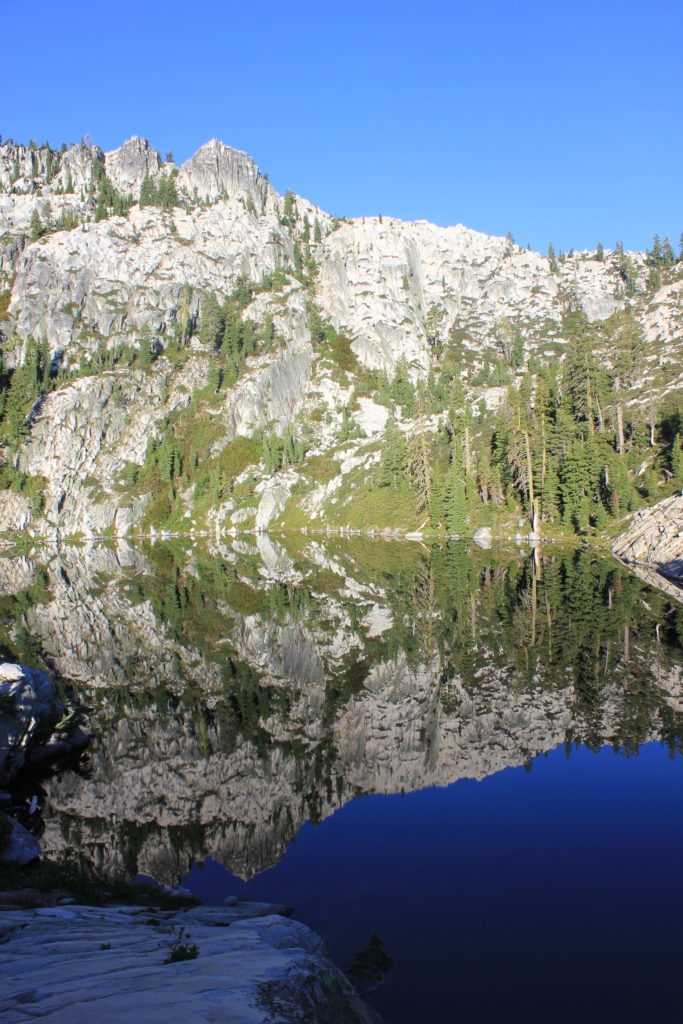
The lake surface was ruffled and windy, but impressive as always. I counted 140 pumps (610 to go), and suddenly glimpsed a white flash and a splash out of the corner of my eye, off toward the western shore. An instant later, I heard the tush! of a high dive. Blinking in the sun, I was thrilled to see an osprey raise her white body out of the water, flapping her dark wings. She gripped a large, writhing trout in her talons as she shook off the water from her feathers in mid-air, and all the droplets sparkled in a corona of sunlight. She circled around in a couple of small victory laps, and displayed the white of her breast as she landed on an old, tall stump to eat her dinner directly across the lake from me. Not taking my eye off of her magnificent aspect, I groped for the glasses behind me and focused on her perch. Yes, it was definitely my osprey familiar from the family Pandionidae, with black bands across her eyes. She tore off a big hunk of fish and discarded it – probably the head – then proceeded to consume the rest of her alpine sushi daintily: with dozens of small bites and gulps. I watched this detail unfold clearly through my glasses, and wished they had a video camera attached! After her meal was finished, she sat still for a time, watching the lake – and surely me as well – with great mastery and contentment.
I practiced a technique I learned in my youth, among the great forest spirits of the redwoods. The art of projecting a sphere of affection from the center of the heart is something that sounds corny, but when applied properly can have stunning results. It’s different from the cloud-busting laser beam because it is all-encompassing. I imagined my love expanding ever outward, from the burning core of affection that lies deep in the center of my being. This circle started as a warm feeling in my chest, radiating outward across the lake to the osprey, and under the water to the fishes, too. It billowed up into the atmosphere to reach the clouds, and enveloped the rocks behind me where I could hear a few chipmunks scrabbling in the bushes. The totality of this sphere of affection took on a life of its own – with me at its center – until a pervasive calm filled the basin, and my nervous system as well. I swore I could see the osprey take notice, as she seemed to regard me from across the lake with newfound respect and camaraderie. Of course she knew I was there, and could see me all too well.
Just a few minutes later, a sudden, deafening roar filled the sky over the basin. Quite unexpectedly, I looked up to see a menacing, metal bird of prey tearing through the sky, merely 1,000 feet above the lake! Its angular, gray underside flashed across the heavens from left to right, and was gone in an instant. The roar of its jet engines followed behind as a zephyr, and soon faded to silence. Astonishingly, an F-16 on a training run had chosen that precise moment to slice directly through the wilderness area where I sat, imposing its incongruous military agenda on my tranquility! I hastily swung my glasses back to locate the osprey, and she hadn’t moved a feather – as if military air traffic was normal, and happened all the time. I wondered what she must have thought about that huge raucous thunderbird, ripping through the atmosphere of her kingdom. A few minutes later she shifted to another tree a few yards away, and I pulled out my camera to see if I could zoom in for a shot. Without a telephoto lens, the view was nowhere near as good as the glasses, so I switched back. For several minutes she just sat, posing, with her dark wings folded and white chest facing me – in exactly the same aspect as the Sentinel rock at the top of Altamira! I grabbed my camera again and snapped a wide photo of them both, hoping I could zoom in on it later, at home. Thoroughly entranced, I put down my gadgets and resumed pumping, watching her in the natural light with my excellent distance vision. As I finished pumping and packed up my gear, she shifted her perch one more time, and I lost sight of her. The 100 yards I walked back to camp was like a dream… did I really just see that? Or was I still inside my tent, dreaming about an osprey?
The wild places are dreamlike and benign, but they will also kill you if you’re not careful. The same can be said about one’s self-esteem. My impure self-image is an artificial construct; the false by-product of processing emotional disinformation for a lifetime. The true Self is like the pure, unspoiled wilderness, which has been encroached upon by the artificial contaminants of the ego. To regain the purity of my Self, I must first learn to love myself truthfully; including all my faults. I have to rip off the head of the ego to consume the nourishment of the essence. One cannot be sustained by the spirit until the flesh is devoured. The osprey is not afraid to dive into the unknown; in fact, it’s the only way she knows how to survive. I need to work at least as hard to delve deep into happiness and love myself again. I have to remember it’s a learned skill, and like any skill there will be good days and bad days. It makes total sense that I should love myself fiercely, because like the osprey, wherever I go, there I am. Since I have to put so much effort into trading my life for money, the least I could do is make it a life worth loving. Just tuck in my wings, and plunge deep into the benevolence.
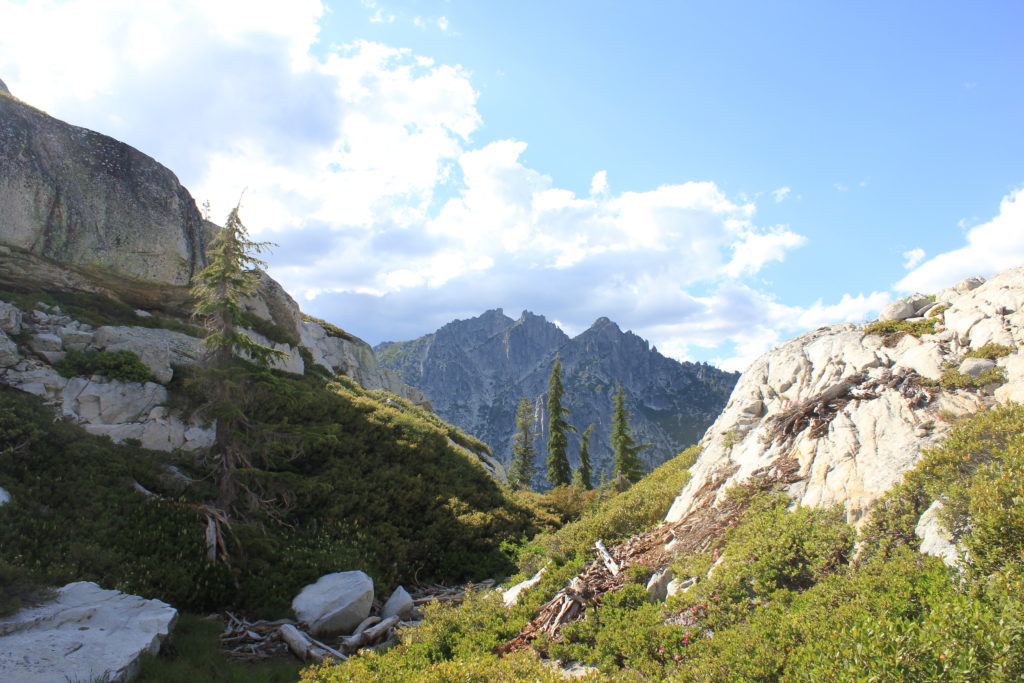
The sun was disappearing below the rim as I gathered my dinner of popcorn and jerky a few minutes later, and headed down to the Altar. Out there in the open, there was still about 45 minutes left before sunset, and I chewed and crunched on my victuals contentedly. I naturally faced Queen Shasta, where the late afternoon light was illuminating her amethyst robe and gossamer crown of vapors. I checked over my shoulder frequently, trying to anticipate if the sun’s trajectory would wind up in the same slot above Big Bear Lake where it had produced such incredible refractive effects three years before. It was going to be close! I set up the camera on top of the Altar, to begin shooting video at the climactic moment, and watched the shadows creep slowly up the wall of Sphinx Rock. The sun kept getting closer – it could still be on the mark – and just when it touched the rim I heard the whoosh of air through wings to my left. Once again, barely 20 feet from where I stood with my hand on the camera, my osprey familiar flew right past the temple bluff, and out into the wide valley towards Sawtooth. I watched her with my mouth open, transfixed with gratitude and affection (forgetting to start the camera), until she turned north with one last flash of white, and disappeared. Meanwhile, the sun was quickly sliding down into the magic slot, and I emerged from my reverie and finally started the video. While chanting the Gayatri Mantra for encouragement, I hoped and prayed the light phenomenon would return. Alas, it was a near miss! Apparently, the sun hit the magical spot just a few days earlier, when I was hiding in my tent from mosquitoes. Fear can make you miss so much of life!
There is great richness to be experienced in the Bear Lakes Basin, but it all requires significant hiking, and devoted attention to one’s footing. I had brought my trekking poles with me for added security on my last evening in the hall of the mountain king, not wanting to risk an unfortunate last-minute injury. Tingling with the energy of all I had witnessed, I packed up my gear and tottered back to camp, where the vampire bugs were waiting impatiently. Their dinner was terribly late, and they were frantic with desperation! Thankfully, they couldn’t reach my skin through the head net and gloves, so I calmly brushed my teeth, gathered up all my night gear, and dove quickly inside my tent, zipping the door behind me with a flourish. If mosquitoes had any teeth, they would have been gnashing them in frustration as I wrote this final entry in my notebook, safe and comfortable on my soft sleeping bag. The long summer daylight was slow to fade away, but soon my trip would be over. All that was left was to get safely back to the car tomorrow morning.
“The same stream of life that runs
through my veins night and day runs
through the world and dances in rhythmic measures.
It is the same life that shoots in joy
through the dust of the earth in numberless blades
of grass and breaks into tumultuous waves of leaves and flowers.
It is the same life that is rocked in the ocean cradle
of birth and death, in ebb and flow.
I feel my limbs are made glorious by the touch
of this world of life. And my pride is from the life-throb of ages
dancing in my blood this moment.
— Rabindanath Tagore