

By the time my sisters arrived at my mom’s house, her empty body was freezing, as if colder than the surrounding air. She was beginning to stiffen, but we knew what she wanted us to do. We gathered around her bed, let down the rails, and the four of us lifted my mom’s husk, still wrapped in the sheets, and placed it with great reverence in the long, thick cardboard coffin that had been left on the floor by the nurse. It was much lighter than we anticipated. She had lost so much weight while the cancer performed its blitzkrieg through her body. The cardboard lid didn’t fit right, and we taped it down so it wouldn’t fall off. We lifted the box, pallbearer-style, and walked it out to the garage to load in the back of her pickup truck.
This is what she wanted: to leave the earth with minimal impact and expense. It was an honor to figuratively prepare her body for burial, and literally drive her to the mortuary. Joy and I hunched in the tobacco-tainted cab of her tiny Toyota, while mom rode in the back for the first and last time.
The cool and vacant morning air was replaced the daily surge of warmth in the afternoon. Without any agenda, or online list of things to do, or cell phone reminders, we managed to accomplish a great assortment of meaningless milestones before dinner. David persuaded my tent to stay up by itself, cleaned up his sleeping gear, and assembled his fishing pole. I tidied up the camp and stowed the food away from varmints. I fantasized about making a raft and anchoring our larder out in the lake, but had disturbing visions of a flotilla of marauding chipmunks in tiny bark canoes. They were much bolder at this campsite, which was by far the most often-used site accessible from the Bear Creek trailhead. Several well-fed specimens just sat around on the rocks all around our campsite, expectantly fixing their beady little eyes on our backpacks, and waiting for us to leave them unguarded. With no dogs around, they were downright disrespectful.
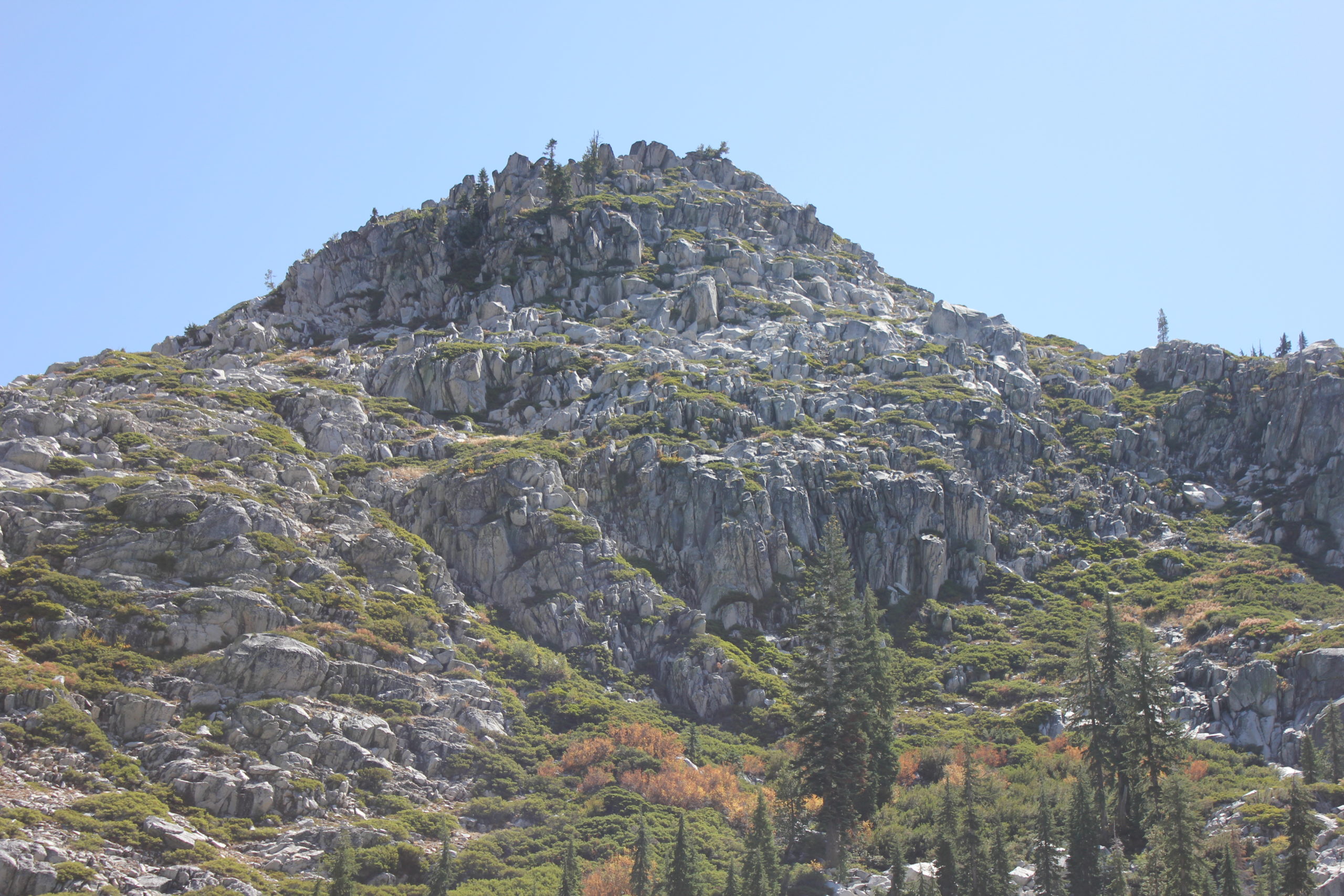
There are really only two areas to explore easily from the east end of Big Bear Lake. The sliding pools of water lay behind us and down a few hundred years to the east, which were now only a trickle late in a dry year. Visiting them meant we would have to walk uphill again to return to camp. No way! We opted for the more level shoreline trail that curves away to the south and west. David’s objective for the day was clear, as he cast his line in a high arc over the still cove, breaking up the magnificent reflections of Sawtooth in the water. My prey was more subtle. I was fishing for redemption. By the time I found a comfortable rock (certainly a relative judgment in this area), I had slipped back inside my mind to search for my lost self; descending deep into the tunnels of suppressed memories, not caring that it might be a steeper climb back to the present moment. Without bidding, I returned again to my first day at this lake with my father.
Then my thoughts turned to memories of my mother, who was also no longer with us. As much as she loved those around her, it had always been so difficult to relax in her presence. Every nuance of a moment was carefully examined, cataloged, and analyzed for traces of doubt and reasons for worry. She had been hurt by so many tribulations in her life that she was always on the lookout for the next grievance. This made it hard to relate on an emotional level, although we both felt things very deeply, indeed. Sitting on my sad little rock in the shade, I searched for a recollection of a sincere hug, or a glimpse of shining reassurance on her face, but everything was a blur of regret. She was such a complex and kindhearted soul, who was tragically handicapped by her resentment of past transgressions both real and imagined. How I longed to have a deep conversation at the level of her true compassion! We did have that one satisfying exchange before she died, but it would have been so much more meaningful if it had been the flowering of a tree instead of an ornament after it had been cut. Why had she been so hard to talk to? If it’s true that the souls of loved ones live on in the memories of those left behind, I surely had some curious tenants.
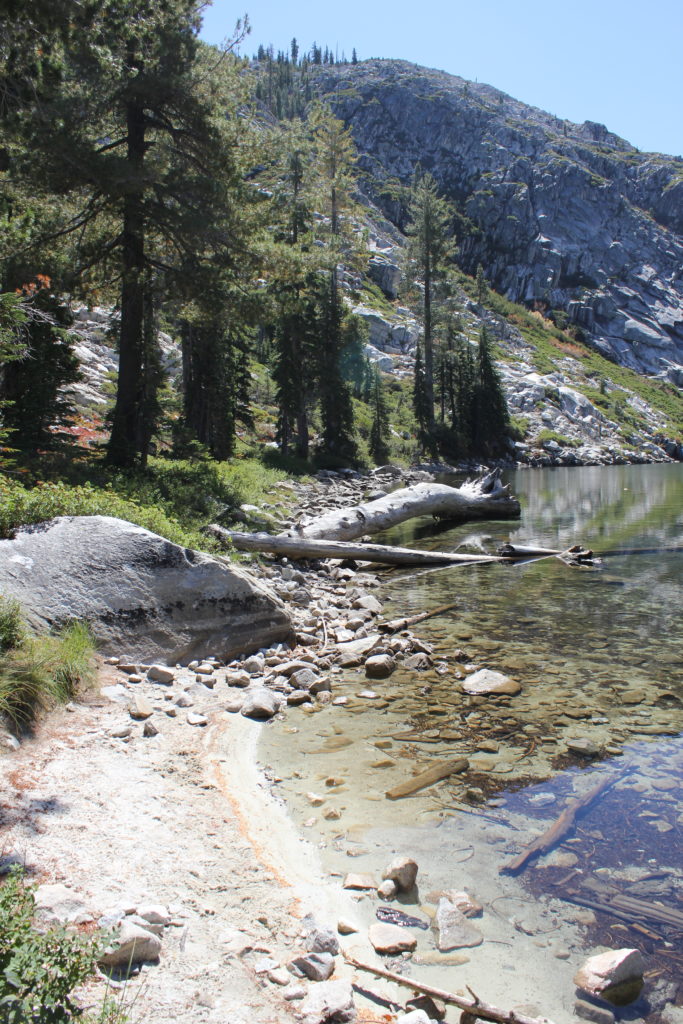
Suddenly, David shouted and waved, and I veered from my idyllic trip down memory lane to see if he had caught a marlin, or perhaps a small whale. Nope, it was a German Brown Trout, jeweled and shiny in the unfiltered sunlight, and gasping for liquid oxygen in the empty mountain air. I felt a quick twinge for her small spirit of life leaving the dance. “That’s about as big as I’ve seen taken from this lake,” I said in genuine admiration, “But the Queen Trout was caught up at Little Bear.” I told him of Greg’s legendary angling adventures just a few hundred feet in altitude above where we were now, but David didn’t take the bait as gullibly as a mountain trout. He wasn’t going anywhere. He had his fish, and his wine, and he didn’t care if the veritable apex of Salmo trutta creation was on the other side of that ridge. He finished the afternoon with three fine specimens, and fantasized about how he would cook them if he were at home, with all the best ingredients and equipment. Our poor wilderness chef would have to make do with the garlic, lemons, and aluminum foil he had lugged up the trail. He must have thought he would catch a few dozen trout, as he’d brought the entire roll of foil with him!
“You should have brought a cast iron frying pan,” I joked.
“I had one ready, but forgot it.” He wasn’t joking.
I explained to him how to roast the fish right on the incredible Ponderosa coals and peel their skins off, but he was determined to test his civilized culinary skills in the backcountry. He carefully cleaned all three of them, and stuffed them with squirts of melted butter and chunks of garlic. These were liberally doused with lemon juice, and a salt and pepper rub. Each was sealed in its own double-layered envelope of foil, and cooked slowly at the edges of the fire. The end result was magnificent, and the Iron Chef kindly gave me a few bites despite my mockery of his utensils. I was so impressed I even did the dishes, including the chopping board and knife he brought.
One nice thing about strenuous hiking and sleeping late out of doors is, you’re not really tired the next evening and can stay up to watch the stars. It’s like jet lag without the jet. I always wanted more time in my life to truly study the stars. Some of the astronomical knowledge for which I yearned were the names and positions of the constellations throughout the year. The problem was, I have always worked like a dog all day, and slept like a bear all night. In the daylight hours, there were no artistic arrangements of stars; just ol’ Sol. It’s kind of hard to stargaze when there’s only one actor hogging the stage. The rarity of a full nighttime sky in all its glory was made all the more memorable by the dramatic way the curtain rose at Big Bear Lake. I was the artist and the heavenly bodies were the audience, expectantly waiting for me to perform.
The granite rim around the lake had an austere finality to it at twilight, as if we were gazing out upon the universe through the mouth of a cave. One by one, the stars winked into the deep indigo fabric. There was no gradual fade in; they just seemed to appear – like Kirk, Spock, and McCoy in the transformer room. How I longed to take my place among them! In the past few years, I could have just given up on everything – my home, my family, my friends – everything that constituted my so-called “life,” but I chose the harder way; as usual. It took all this time to work out my problems and learn to love myself again. It’s easy to love yourself when everything is going right. It takes the grace that only comes from God to truly love that which is imperfect; even awful at times. The silent stars understand. The universe is a horrific place at times, with black holes and exploding supernovas annihilating trillions of life forms, and yet they forge millions more in the crucible of their destruction. My own life had known that paradoxical destruction and transformation – from ravaging treachery to unimaginable redemption. I contemplated all of the infinite cosmos through the holes in my skull, and concluded with satisfaction that my relationship to the universe was just as it should be; regardless of my opinion of it.
A gentle breeze stirred the pine boughs above us. I could see their black shadows shifting against the luminous backdrop of the spiral arm of the Milky Way. It seemed as though the trees were enjoying the starlight as much as I was. “Nice night,” I said unnecessarily to David, who grunted in agreement. The stars appeared to be arcing across the sky, but of course it was we who were hurtling past, bound by an involuntary attachment to a planet-sized rock spinning somewhere in the outskirts of an obscure galaxy. Pulled in opposite directions by centrifugal force and gravity, we rode the colossal carousel around and around. The faces of the crowd swept by like memories on the lunar winds. The trees rose and fell like horses on a pole, and the distant sound of a melancholy calliope echoed in my eardrums.
These lower realms of physical existence may be described as an amusement park for evil and bad vibrations… or perhaps a recycling center. Various manifestations of life filter through it, and the salvageable bits are made clean if they are receptive to letting go. Those who cling to the material world get trapped and accumulate more negative tendencies; each according to their predilections. In this way our planet functions as a giant strainer that tries to clean itself, but is getting more and more clogged with accumulated grime. The earth has tremendous inherent beauty, which it offers to us freely, and her marvelous gifts are being desecrated by mankind’s penchant for delusive conquest. Our living home also wields tremendous power, as every form of life fights to the best of its ability to retain its equilibrium; its own version of homeostasis. What will happen when the dynamic earth decides to clean its filter of the accumulated filth, including us?
I imagined being shot outward from the surface of our planet through this hole in its crust, expelled ignobly to drift endlessly in space. I was an infinitesimal speck of dust, wandering with the solar winds and looking for a place to belong. Maybe I wasn’t meant to be on this planet at all. Maybe someone made a mistake, and like a tourist getting off at the wrong bus stop, I still had more work to do in order to reach my destination. I wished I had known that there was somebody to help me make the journey, and reach out and catch me when I fell. Jesus had always been there, suffering with me and wishing I would let Him help me. I thought of the famous “footsteps” poem, where there was only one set of footprints on the sand because Jesus had been carrying the afflicted. Like that poor soul, I thought I had been travelling alone, and suffered the worse for it. It is a great and painful paradox that one must completely surrender to become genuinely powerful. Some are lucky, and have a close friend, a teacher, or family member to show them the way. If there had been someone in whom to confide, would I have reached out for help? Or more realistically, would I have accepted any help that might have been offered?
We’re all here to help each other, but we also hate being told what to do. How can a gift be given if the delivery is refused? If we despise our behavior when it’s less than what we hope it to be, why do we resist when our shortcomings are pointed out to us? We should rejoice that we have found the vital flaw to be corrected, because that’s why we are here. The problem is, very few people are skilled at positively adjusting the behavior of others. In fact, most of humanity is indisputably ineffective at correcting the behavior of anyone else. This is made more pernicious by the fact that we spend most of our time trying to do just that. All too often, destructive criticism is inflicted with a blunt word, a bullet, or a nuclear bomb. We’re like a surly, belligerent courier trying to deliver a package to a hostile, paranoid recipient. This developing plot for a disaster movie is being played on the screens of our minds and our televisions, on nearly every channel, all the time.
When most of us think of Jesus, why do we feel guilty? Why does it set off a chain reaction of emotions that ultimately compels us to dismiss everything for which He stands? We feel guilty because we know unequivocally that we are sinners. We stubbornly resent being reminded of that, just as an ugly person hates looking in a mirror. We feel repugnant before His grace and purity, and so we reject the standard to which we compare unfavorably. Our focus is on the negative contingencies and not the positive reality. It makes us so uncomfortable to consider that He died for our sins that we lose sight of the eternal truth that all of us live forever, in a sinless essence beyond death.
The journey to find the broken pieces and put them back together requires a focus on the big picture. You are not alone. There is something infinitely bigger and more important than you out there, and it is calling you back to wholeness in the spaces between every moment; all the time. Dwell not on the brokenness, but marvel at the way the pieces fit together. Few of us will find all the fragments we need. There may be just a few bits out of place, or there could be gaping holes of disarray where nothing seems to make any sense. Sometimes it’s like trying to assemble a huge jigsaw puzzle without having a picture on the box. Concentrate on the smaller accomplishments, and be alert for the larger solution to emerge. It might take several lifetimes to find the missing parts that join together, and put them where they fit. The pieces don’t go away; they must be put in their places. There is no other reality.
We are the first human beings in the history of our species to know with certainty our exact place in the visible universe. With this knowledge comes great responsibility. There are significant contributions each of us can make when we realize we are answerable for acting upon what we know. We are all part of a continually unfolding, super-evolving, universal community of life expression, and yet we are but one part of a countless multitude. What on earth can we do to contribute in a meaningful way? The vital, fundamental thing is that we are here. By existing, we are obligated to be the best expression of life that we can be; in all the ways we know we must. We are not limited to being just a minuscule part of the universal plan, but we can’t do anything bigger until we do this one thing for which we are primarily responsible: to be as good as we can be; as often as possible.
The best part is: this is the one sure thing over which each of us has control!
“One of the reasons why we crave love, and seek it so desperately, is that love is the only cure for loneliness, and shame, and sorrow. But some feelings sink so deep into the heart that only loneliness can help you find them again. Some truths about yourself are so painful that only shame can help you live with them. And some things are just so sad that only your soul can do the crying for you.”
— Gregory David Roberts